


Auger drive unit attachments

Exceptional quality, performance, and durability for any drilling application.
Hydrapower’s superior line of Australian-made hydraulic auger drive units is specifically designed to meet the toughest drilling demands.
Whether for post hole digging or tree planting, get the necessary power and versatility to tackle the most challenging ground conditions with ease.
Engineered to bore deep, precise holes, our auger drive unit attachments deliver dependable torque, speed, and accuracy. Explore the full range for sale today.
Showing all 6 results


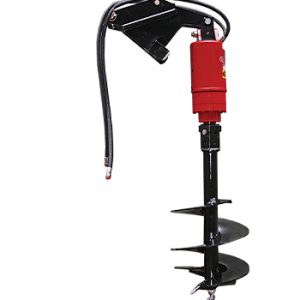


Australian-made auger drive units for skid steer loaders, excavators, and more
Achieve unparalleled results and reliability with Hydrapower. Our wide range of auger drive units offers the ultimate solution for skid steer loaders, excavators, backhoes, tractors, and telehandlers.
Designed and manufactured here in Brisbane, Australia, these units are equipped with top-of-the-line European hydraulic motors and custom-made gear sets.
Built to stand the test of time from the highest quality materials, every attachment surpasses the strictest quality and performance standards.
FAQs
What is an auger drive?
An auger drive is a motor that delivers the torque to rotate an auger bit, which drills holes into the ground. Together, these components dig deep, clean, and consistent holes through soil, clay, and even rock.
As our auger drives run off your machine’s hydraulics, they offer far more power and control than manual or basic mechanical options.
How does a hydraulic auger drive work?
A hydraulic auger drive uses the host machine’s hydraulic flow to turn an internal motor. This force is passed through a planetary gearbox, which slows the speed and multiplies torque, to the auger bit.
That’s what gives the machinery attachment its drilling strength. The steady, controlled rotation lets the auger bit cut through the ground without stalling or overloading your machine.
Most units also allow reverse rotation, which helps clear spoil and free the bit if it binds in tough conditions.
How does a hydraulic post hole auger unit differ from a PTO post hole digger?
While both tools are used to drill holes, hydraulic post hole auger units and PTO post hole diggers differ in their process and performance.
Auger drive units are high-torque, hydraulic attachments engineered for consistent, high-output drilling across civil, construction, and agricultural sites with diverse soils.
On the other hand, a Power Take-Off (PTO)-driven post hole digger transfers engine power to an attachment. This type of tool is better suited to agricultural and site preparation tasks where conditions are predictable, and precision is less critical.
Here’s how that plays out on site:
- Speed and productivity: Auger units deliver rapid, repeatable drilling with minimal interruption. They’re built for high-throughput work where multiple holes need to be drilled efficiently. Meanwhile, post hole diggers are slower and often require stopping to clear spoil, which reduces overall productivity.
- Power: Hydraulic auger units use machine power to generate torque to keep operator effort low and performance consistent. In contrast, PTO units offer limited torque control.
- Depth, accuracy, and finish quality: Auger drives produce deeper, straighter, and more uniform holes, which is critical for structural applications like footings and piling. Post hole diggers are more limited in depth and can struggle to maintain alignment, especially in variable ground.
- Performance across ground conditions: Auger drive units can cut through harder ground conditions like clay, compacted soils, and rock. Post hole diggers are generally restricted to softer soils and lose effectiveness as resistance increases.
- Control, visibility, and safety: Machine-mounted auger drive units provide better positioning, visibility, and control, particularly on loader or excavator setups. PTO-driven diggers, mounted at the rear of tractors, can be more difficult to align accurately.
When should I use an auger drive unit?
Typically mounted on machines like skid steer loaders and excavators, an auger unit attachment is used across construction, agriculture, and civil sites for fast, repeatable hole drilling without the manual workload.
This versatile tool can be used for applications such as:
- Fence and post installation
- Deck, pier, and footing construction
- Shrub and tree planting
- Utility poles and signs
- Ground anchors and screw piles
- Foundation and piling work
- Solar farm installations and civil projects
This powerful tool is especially valuable on jobs where consistency, precision, and productivity are paramount.
Which machines are compatible with auger drive unit attachments?
Most hydraulic carriers can run an auger drive, as long as the flow and pressure are suitable for the attachment.
Compatible machines can include:
- Skid steer loaders
- Excavators
- Compact track loaders
- Mini excavators
- Mini loaders
- Telehandlers
That said, matching the drive to your specific machine is essential. Too small, and you’ll struggle in tough ground. Too large, and you risk inefficiency or damage.
How do I choose the right auger drive unit attachment for my machine?
The right auger drive unit comes down to matching the attachment to your machine, your ground conditions, and drilling requirements.
Here are the key factors to bear in mind before you buy:
- Hydraulic flow and pressure: Your carrier machine determines what the auger drive can handle. Match the drive to your machine’s optimal flow range to avoid slow performance or overheating.
- Hole diameter and depth: Larger and deeper holes demand more torque to maintain cutting speed. Undersized drives will stall, drill slowly, and increase wear on both the attachment and machine.
- Soil and ground conditions: Soft soils are easy to drill, but clay, compacted ground, and rock require higher torque and more robust setups. If you regularly work in tough conditions, it pays to size up.
- Mounting and machine compatibility: Make sure the hitch and mounting system suit your machine. Proper alignment and visibility strengthen accuracy, control, and operator safety.
- Frequency of use: A smaller unit may suffice for occasional jobs. If you’re performing regular or heavy industrial work, investing in a higher-quality, higher-torque unit can improve reliability and productivity.
If you’re still unsure which auger drive unit is best, contact our technical team for tailored advice. We can help to determine the ideal machinery attachment for your next project.